Myfanwy’s Amnesia and Reconstruction of Identity
The RookMyfanwy’s amnesia and reconstruction of identity begin with a stark division: she wakes in Myfanwy Thomas’s body, but does not experience herself as the woman whose name is on her prescription. The novel makes memory loss more than a missing past. It becomes a practical and moral choice between escaping a dangerous life prepared by someone she cannot remember and taking that life over, while the new Myfanwy learns what, if anything, makes the body and its history hers.
A self encountered through traces
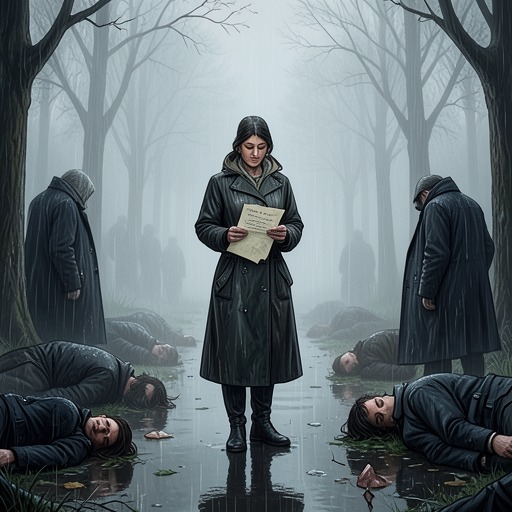
In the rain, the amnesiac finds two letters in her jacket, one addressed simply to her and another marked with the number two. A prescription box identifies the name Myfanwy Thomas, while an EpiPen in the pocket offers a concrete clue about the body she inhabits. Around her lie motionless figures wearing latex gloves. She has no memory to explain the scene, but the objects and bodies make clear that her predicament is not an ordinary lapse: she has entered a life already in danger, carrying evidence of an attack she cannot recall.
At first, the name itself feels like an imposition. The woman in the body resents that she cannot even begin anew without knowing what she is called, and refers to the prior occupant as someone who has left her in trouble. Her uncertainty extends beyond personal history to the most basic questions: her age, work, family, and friendships. She tries to reason from what can be inspected—no rings or tan lines to suggest marriage, and a bank balance she has not yet checked—but such clues cannot restore lived experience. Even the title Rook, encountered in a dream, is puzzling; she reasons that she cannot literally be a bird because she has no feathers.
A dream gives this discontinuity an unusually precise formulation. When another woman recognizes that the mind before her is different, the amnesiac explains that Myfanwy Thomas has lost her memory and that she is what woke up. She reluctantly accepts the woman’s description that she is in Thomas’s body. The exchange distinguishes bodily continuity from remembered identity without settling whether the new consciousness should be regarded as a successor, an occupant, or the same person altered by the loss.
The former self’s letter and the choice of a life
The letters left by the former Myfanwy anticipate the rupture and give it a structure the amnesiac herself lacks. The writer says she knows she will lose her memory, although she does not know why, and hopes to make the transition easier. She predicts an attack, a fight, and a victory, and stresses that the attackers will wear latex gloves. That detail is not incidental: it points to a betrayal by someone the former Myfanwy should have been able to trust, though she cannot identify the betrayer or explain the motive. She has placed copies of the letters in every coat and jacket so they might still be found when needed, an act of preparation against a future she can anticipate only partially.
The most consequential letter does not dictate what the successor must become. Instead, it presents two alternatives and leaves the decision to her. She can leave the country, use the former Myfanwy’s money, and follow instructions for constructing a new identity; or she can adopt the existing life, investigate the betrayal, and accept its wealth, power, knowledge, and danger. Two keys at the Mansel Bank make the choice tangible: box 1011-A contains the materials for departure, while 1011-B returns her to the former Myfanwy’s life. The writer acknowledges the unfairness of asking someone with no remembered past to choose her future, but insists that the choice belongs to the person who wakes.
The amnesiac’s first questions are therefore not simply about recovering facts. They concern whether she is obliged to inherit another woman’s relationships and responsibilities. The letter offers a possible escape, but not a guarantee of safety; it describes a life outside the country that could be made as secure as the former Myfanwy can arrange, while conceding that it could never be completely safe. Staying means accepting the risk of an unknown enemy in exchange for the chance to learn why she was attacked. The old self can prepare the doors, but cannot walk through one for her.
Learning the body and entering the role
Although autobiographical memory is absent, the amnesiac is not without capacities or evidence about herself. A letter from the former Myfanwy assumes that she has touched someone and disrupted that person’s control of their body, and connects this involuntary manifestation of her ability to the choice of a particular box. The former Myfanwy explains that pain can trigger the power unconsciously, and recalls its first manifestation at age nine. After a fall from a tree left a sharp branch lodged in her leg, a doctor touched her bare skin and lost control of his legs; a second hospital worker then lost her sight after touching her. The episode supplies a history of the power that the new Myfanwy cannot remember, while also making her body an active source of knowledge—and danger.
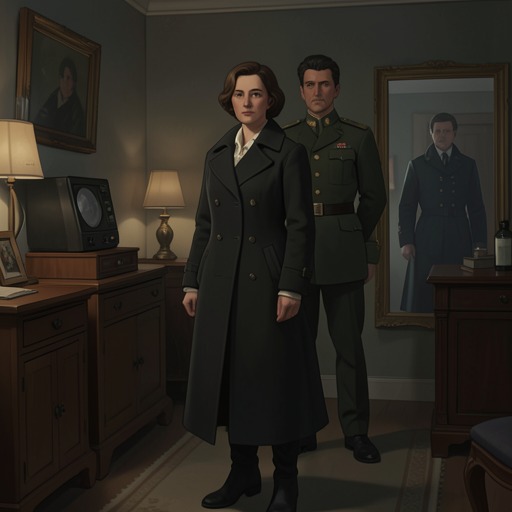
Her return to work marks a further step from observation to participation. After sleeping and reading the dossiers left by the former occupant, she wakes at five on Monday morning, worried that she is late. Staying alone in the prepared apartment seems worse than going in to discover what is happening. She selects a suit already chosen by the former Myfanwy, then takes up the large purple binder. The gesture is both practical and symbolic: she can use the predecessor’s preparations while beginning to act in the role herself. The documents supply institutional information, but do not restore the personal memories that would make that information feel like hers.
The narrative preserves this unevenness. The new Myfanwy can deliberate, investigate, and make decisions, yet she sometimes describes the former occupant as Thomas, as if personhood belonged to the one who lived the remembered past. Her uncertainty is not resolved simply by learning the correct name or reading a dossier. Instead, she tests the identity through acts—going to work, making choices, and forming relationships whose significance arises in the present rather than from remembered experience.
Bronwyn and the feeling of belonging
The most powerful change comes through the revelation that Bronwyn Thomas is Myfanwy’s sister. At first, the amnesiac is stunned by the resemblance: Bronwyn has features like her own, though she is taller, more beautiful, and has long highlighted blond hair. Recognition does not arrive as recovered memory. Myfanwy sees Shantay staring, hears the world seem to go quiet, and feels an affinity that resembles familiarity, as though Bronwyn fills a sister-shaped absence. The relationship is disclosed from outside her memory, yet it carries an immediate emotional force.
When the two embrace, Myfanwy feels her powers flare and senses their genetic connection: Bronwyn’s patterns mirror her own to a degree. She draws back to look at her sister and then pulls her close again, laughing and weeping at once. This is bodily and relational knowledge rather than recollection. The encounter does not return a scene from childhood; it gives the amnesiac a present-tense bond that she can recognize as hers.
That recognition changes how she understands inheritance. She has thought that everything else belonged to Thomas’s life and had merely been handed down to her. Bronwyn, by contrast, is the sister of the body Myfanwy now inhabits, and Myfanwy concludes that the body is as much hers as Thomas’s. She finally relaxes into herself. The distinction is not that the former Myfanwy’s past becomes available, but that the new Myfanwy can claim a genuine relationship and a body without treating herself as a stranger lodged inside it.
When Bronwyn tells her that their parents are dead, information Myfanwy had already encountered in files becomes newly real. On paper, they were the dead parents of an inherited body; spoken by her sister, they become her parents, and their loss brings a piercing regret. The contrast shows how knowledge and autobiographical belonging differ: a fact may be intellectually available before it becomes emotionally hers. Family connection makes the former occupant’s history more than a dossier, without erasing the gap in memory.
A chosen identity under threat
Taking on the life does not give Myfanwy a complete account of how the attack happened. Later, when the group discusses the revelations about Grantchester and the Grafters, she conceals her amnesia. She keeps her account of her recent experiences deliberately vague, avoids fully explaining what happened, and feigns light-headedness to escape a complete debriefing. The bruises around her eyes draw attention, but the others are preoccupied by the larger revelations and do not connect them to the earlier injuries. She also withholds details about Norman’s capabilities, and no one mentions that anyone has lost their memory. Her developing identity therefore includes a tactical silence: although she has chosen to act within the former Myfanwy’s world, she does not yet trust the Court with the fact that she cannot remember it.
The reconstruction remains incomplete, but it is no longer simply imposed by a name on a medicine box or a collection of files. The former Myfanwy supplies warnings, a history, money, instructions, and a way back into her professional life; the amnesiac supplies the decision to use them. Her bodily abilities connect her to the past in involuntary ways, while Bronwyn makes kinship emotionally present. The novel’s account of identity rests in that tension: memory cannot be restored by evidence alone, but a life can become one’s own through chosen action and relationships that take root after the loss.